What Does Crowdfunding Mean?
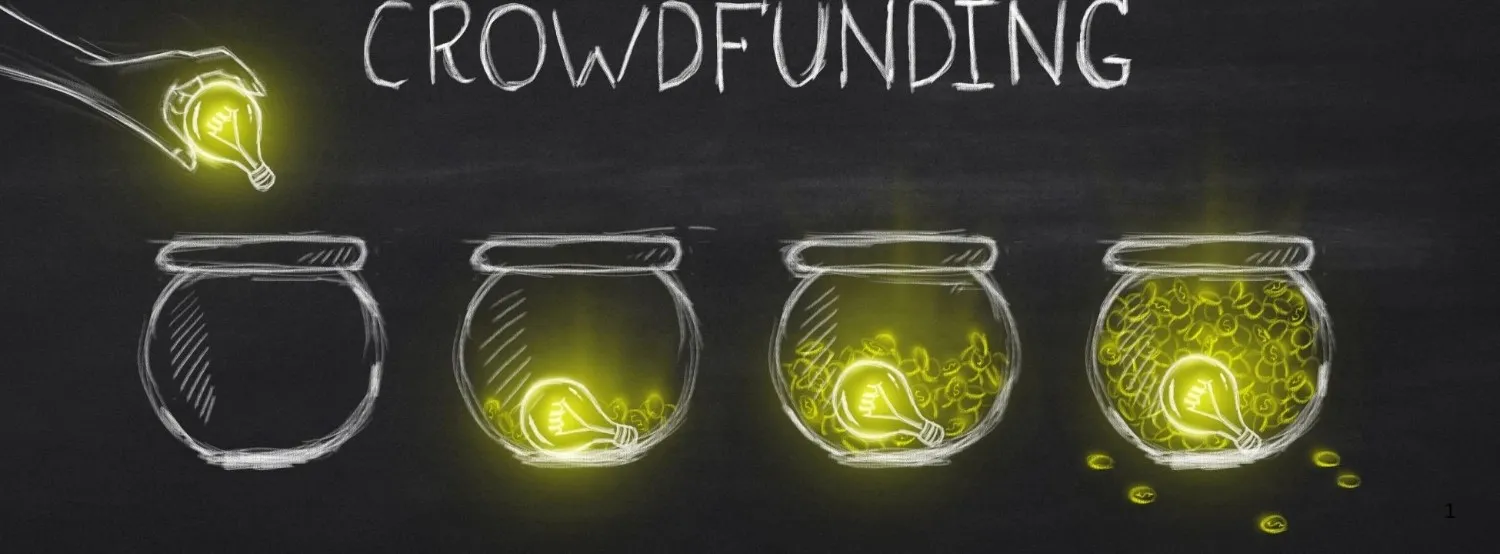
"crowdfunding" Using a small amount of money from many people to support a new business venture is known as crowdfunding. By making large networks of people easily accessible through social media and crowdfunding websites, crowdfunding means linking investors and entrepreneurs. It has the potential to boost entrepreneurship by enlarging the pool of investors beyond the conventional circle of owners, family members, and venture capitalists. Numerous industries have benefited from this type of fundraising, particularly corporate support and humanitarian purposes.
In a nation like India, crowdfunding has swiftly emerged as the most efficient means of generating money for a variety of business support and humanitarian purposes. This is because Indian culture has a long history of charity, creativity, and connection. Crowd funding is an inclusive financial tool that connects corporations, organizations, and individuals, filling resource gaps and offering financial support for a variety of causes. Let us clarify crowdfunding before we discuss how it operates in India.
The saying "every drop forms an ocean" may be familiar to you. Crowdfunding and how it works is a prime example of this saying. Through crowdfunding, a group of people collaborate to generate funds for a certain cause. In order to help the fundraiser achieve a larger objective—whether it be for community support, social activities, or business launches—donors provide whatever financial resources they are able to.
Start a Campaign: How It Works
What is the process of crowdfunding, then? Who are the participants, and what is the process? If you wish to participate in the online crowdfunding ecosystem as a donor or a recipient, these are crucial factors to take into account.
Three parties are typically involved in a fundraiser: the donors, the crowdfunding platform, and the beneficiary. The individual who starts the campaign and needs the money is the beneficiary. Crowdfunding campaigns can sometimes be started by a non-profit or by a person on behalf of a benefit or beneficiaries. A crowdfunding organization, like Care India Welfare Trust, is in charge of the campaign. Donors are those who use the platform to contribute to the cause.
Through crowdfunding, companies have been able to raise hundreds of thousands or even millions of dollars from investors. Anyone with an idea can pitch it to a group of interested investors through crowdfunding.
Kinds of Crowdfunding
The term's two most common uses are for the kind of crowdfunding carried out by individuals who have experienced an emergency and by start-up businesses looking to launch a good or service. Thanks to crowdfunding services offered by organizations like Care India Welfare Trust, many people who have suffered from a natural disaster, a significant medical bill, or another miserable event, such as an accident, have received financial aid that they would not have otherwise received.
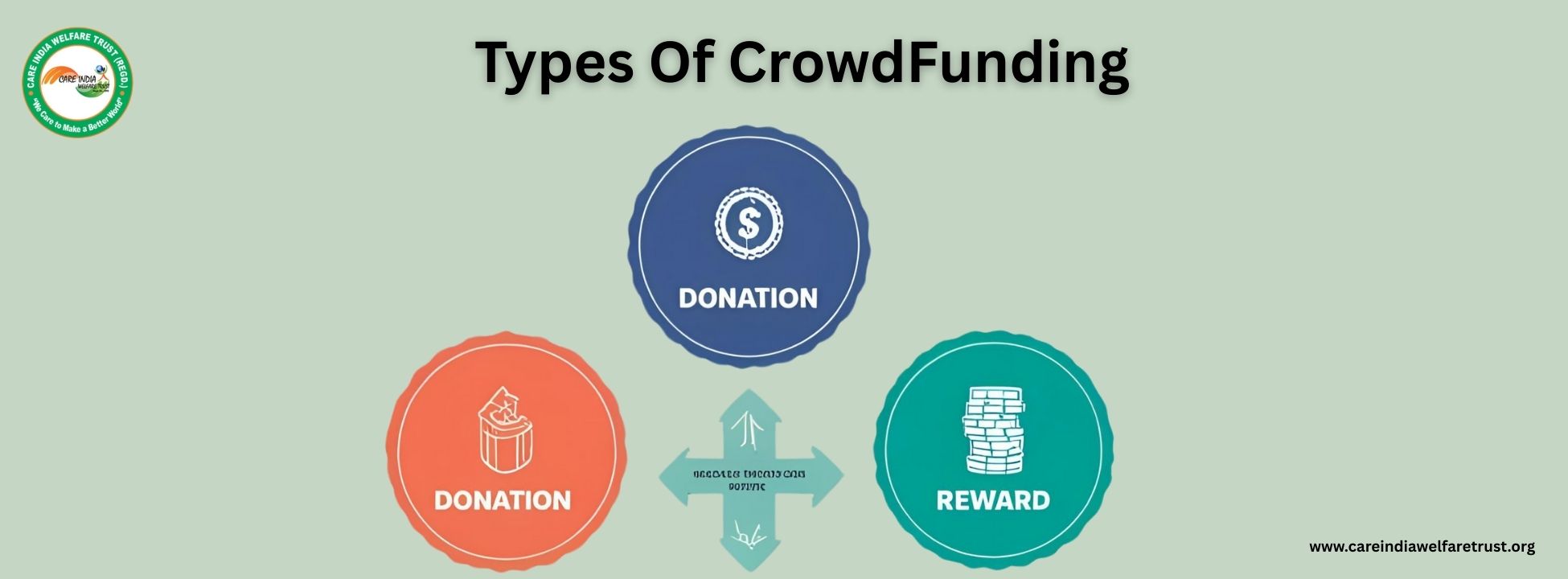
Three forms of crowdsourcing are common in a nation like India:
- Donor-Based Crowdfunding:- The simplest type of crowdsourcing is called "donation-based crowdfunding," in which donors give money to a cause without anticipating anything in return. A sense of altruism and a desire to help a specific cause, such as medical expenses, disaster aid, or societal issues, are what drive donors. Crowdfunding of this kind is usually utilized for community projects, humanitarian endeavors, or charity purposes. On websites like GoFundMe, where contributors donate money just to aid others, it is typical.
- Prize-Based Crowdfunding:- In this type of crowdfunding, supporters trade their financial contributions for a prize, usually something associated with the business or project they are sponsoring. For instance, a backer of a creative project can receive special versions of a book or piece of art, or someone sponsoring a new tech device would gain early access to the product once it launches. Startups, artistic endeavors, and product debuts frequently employ this kind of crowdsourcing, and websites such as Kickstarter and Indiegogo are well-liked for this approach.
- Peer-to-peer lending, or lending from peers:- Peer-to-peer lending, or P2P lending, is a type of crowdfunding in which people lend money to one another with the understanding that they will be reimbursed, typically with interest. Peer-to-peer lending platforms put lenders and borrowers in direct contact, in contrast to traditional bank loans. It is frequently utilized for financing businesses, personal loans, and other endeavors. Borrowers gain from an easier means to obtain money outside of conventional banking institutions, while lenders profit from interest payments. This strategy is popular on sites like Prosper and LendingClub.
However, several crowdfunding websites, including Patreon and Substack, have broadened the definition of crowdsourcing in recent years to give creative people, whether they be writers, painters, musicians, or podcasters, a way to support their creative endeavors while earning a steady income.
Equity-Based Crowdfunding:
Equity crowdfunding enables investors to participate in the business by trading money for equity shares. In proportion to their investment, the equity owners receive a cash return (a dividend or distribution representing a piece of the earnings). This is the most prevalent kind of crowdfunding.
Reward-based crowdfunding:
It involves people giving money to a company in return for a benefit, which is frequently a type of good or service the company offers. In this type of financing, the distance between the investor and the innovator is unimportant. Rewards-based crowdfunding shares several characteristics with non-equity crowdfunding. This type of funding is used in many contexts, including the development of new technologies, scientific research, marketing films, civic projects, and free software.
Crowdfunding Based On Donations / Peer-to-Peer Lending:
Asking a lot of people to give a tiny amount without expecting anything in return is one way to raise money for a project.
There is no need for anything in return, and this type of funding is mostly utilized for social goals. Common revenue streams include natural calamities, disaster aid, charitable contributions, and medical expenses; Care India Welfare Trust provides support for these causes via its platform.
Advantages of Crowdfunding
Access to a wider and more varied pool of investors and supporters is the most evident advantage of crowdfunding for a new business or individual. Due to social media's expansive use, crowdfunding investment advantages platforms are a great tool for both individuals and businesses to reach a wider audience and get the funds they need.
Furthermore, a lot of crowdfunding and tax benefits programs offer incentives to investors, such as the chance to take part in the introduction of a new product or receive a prize in return for their money. For instance, every investor in a new bacon fat soap company would receive a complimentary bar. The most popular crowdfunding investment for
Gamers are video games, and in exchange for their contributions, they are often granted early access to the game. Because it enables entrepreneurs to obtain financing without surrendering control to venture capitalists, equity-based crowdfunding is becoming more and more popular. Additionally, it can give investors the chance to own a share of the company. In the US, the Securities and Exchange Commission (SEC) oversees equity-based crowdfunding.
Some Additional Benefits of Crowdfunding Are as Follows:
- It gives money to a lot of innovative concepts.
- It offers tax breaks to a large number of new businesses in the country.
- During natural disasters, crowdfunding is useful for promoting social causes.
- It is also useful in securing funds for poor people who cannot afford the costs of serious illnesses such as cancer and kidney transplants.
- The ability to consolidate and streamline fundraising efforts is one of the best features of internet crowdfunding, such as that provided by Care India Welfare Trust.
Disadvantages Of Crowdfunding
Here are some disadvantages of crowdfunding explained in simple language:
Not Guaranteed Success: Just because you launch a crowdfunding intern meaning campaign doesn’t mean it will succeed. Many projects fail to raise the necessary funds, even with a lot of promotion. If you don't meet your funding goal, you may end up with nothing.
High Fees: Crowdfunding platforms usually charge a fee for using their services. These fees can take a percentage of the funds raised, which means you may end up with less money than you expected after all the deductions.
Time-Consuming: Running a crowdfunding campaign takes a lot of time and effort. You need to promote your project, manage backers, update the campaign, and handle any questions or issues. This can be stressful and time-consuming.
Public Exposure: Crowdfunding campaigns are public, meaning everyone can see your idea and how much money you've raised. If your campaign doesn’t do well, it can affect your reputation, especially if people criticize your idea.
No Control Over Donors: You may get a large number of small donations, but you have limited control over who donates and how much they give. This can make it difficult to reach your goal if there aren’t enough big donors.
Legal Risks: If you promise rewards or returns to backers and fail to deliver them, you could face legal issues. It's important to communicate what you can deliver and when, as failing to meet your promises can lead to problems.
Competition: There are many projects and campaigns on crowdfunding defined platforms, so your project may get lost in the crowd. It can be hard to stand out and attract enough attention from potential donors.
Reliance on Social Media: Many crowdfunding campaigns rely heavily on social media for promotion. If you don’t have a large online following or marketing experience, it may be difficult to get enough visibility to succeed.
Potential for Failure: Even if you do raise the funds, there’s still a risk that your project won’t succeed due to unforeseen challenges, poor planning, or execution problems. Raising money doesn’t guarantee that your project will be successful.
Fundraising and Taxation Laws in India
Donations to certain non-profit organizations in India are tax-deductible. Individuals who donate to a non-profit organization having a valid 80G certification may be eligible for a tax deduction of up to 100%.
Simply explained, if you donate to a registered charity organization, it counts as a 50% or 100% deduction from your gross annual income. This lowers your taxable income and allows you to save even more money. You can claim deductions with or without an ‘upper limit,’ depending on the charitable trust.
Make sure the non-profit you’re donating to, such as Care India Welfare Trust, has its 80G accreditation to take advantage of the crowdfunding tax rules. You will receive a donation receipt once the donation has been made, which must be provided when claiming tax deductions.
Crowdfunding and Tax Deductions
In Care India Welfare Trust campaigns, after deducting platform fees, PG fees, and GST, the money raised can be withdrawn. The amount left over after this deduction may be subject to taxation in India.
Fundraisers who qualify for a tax exemption will have this information displayed on their campaign page. In the acknowledgement email, you’ll also get a notification if you made a tax-deductible donation to a fundraiser. If the information is not included in your email, the donation will not be eligible for tax exemption.
To get your 80G receipt, follow the steps below:
- Go to the Care India Welfare Trust account that you used to make the donation and sign in.
- Click on the profile and then go to the donation history
- Click on the download 80G to download it in the PDF format.
What Is Crowdfunding and How Does It Work?
If you think crowdsourcing is a novel concept that is slowly gaining traction, think again. It has been done in India since ancient times, mostly to raise funds for cultural and religious objectives. Back then, we dubbed it “Chanda.” Crowdfunding, as we know it now, emerged in the West and is one of the finest financing choices for any cause cloud funding meaning, particularly if it has a broad appeal.
Conclusion
So that’s all there is to know about the definition and sorts of crowdfunding. However, numerous examples of cybercrime are occurring in this digital age. We have heard of cases of fraud, especially when it comes to crowdsourcing donations for cancer treatments. So investors must carefully assess the cause they are contributing to.
Care India Welfare Trust is a crowdfunding assistance platform that raises donations for a variety of causes, including NGOs, non-profits, and creative and personal causes. It enables people across India to support one another in times of need and is committed to transparent, responsible fundraising.
FAQ
What is Crowdfunding in India?
Crowdfunding in India means raising small amounts of money online from many people to support a cause, project, or business idea.
How Do Crowdfunding Platforms Handle Investments From Able Accounts For Individuals With Disabilities?
Crowdfunding platforms follow special rules to safely manage investments from ABLE accounts for individuals with disabilities, ensuring legal protection.
What is Crowd Financing?
Crowd financing is when many people give small amounts of money to support a business, project, or cause, usually through online platforms, helping raise needed funds from the public.